We’re moving on to the fourth and final division with the Contention Roadmaps. Last time, we looked at the Atlantic Division. This time, we round out the Eastern Conference in the Metropolitan Division.
If you aren’t already familiar with my definition of player tiers or other concepts used in the team analysis below, you can catch up with with some previous posts:
Metropolitan Division Contention Roadmaps
As we did for the previous posts, we’ll look at the Metropolitan Division teams in order of the current standings before we postulate what the division might look like five years from now.
Carolina Hurricanes
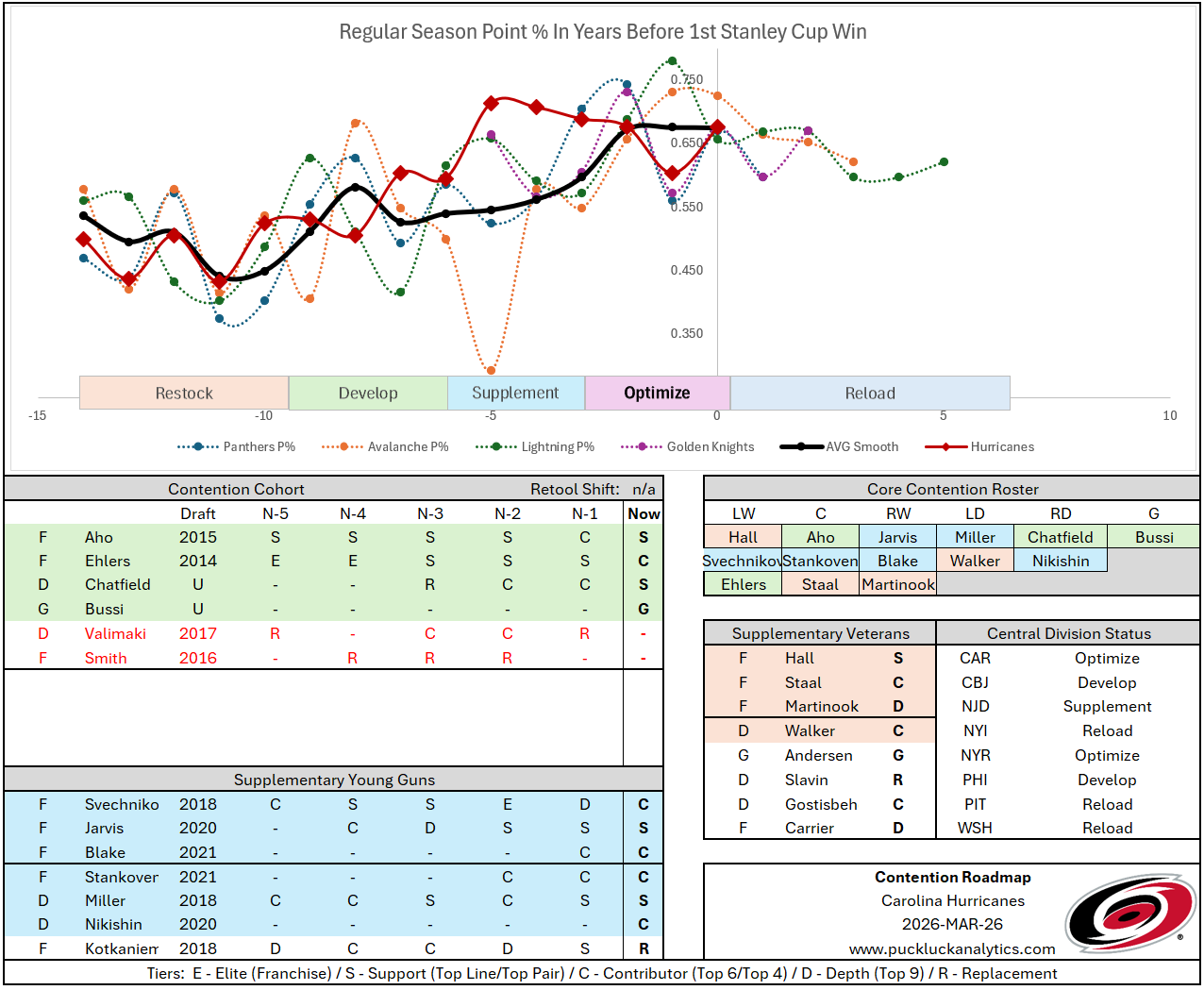
Since they returned to the playoffs in 2019 after a nine year postseason drought, the Carolina Hurricanes have transformed into a power in the Eastern Conference. They’ve been on some long playoff runs too, but have so far failed to make the Stanley Cup Final with this core.
The knock on the Hurricanes in recent years seems to be that they haven’t been able to acquire and/or retain truly top end talent. A big swing last year that landed them Mikko Rantanen turned into a short experiment that converted some NHL pieces into futures and younger players instead. The Contention Cohort is thin right now as well, however it’s a mix of both veterans and young players picking up the slack. With a large crop of good NHLers already in the Young Guns group, the Hurricanes look well positioned to keep hold of their standing as the Metro’s top dog for quite some time. The big question is whether they can find a way to add an Elite tier player or two to push them to the next level of playoff success.
Columbus Blue Jackets
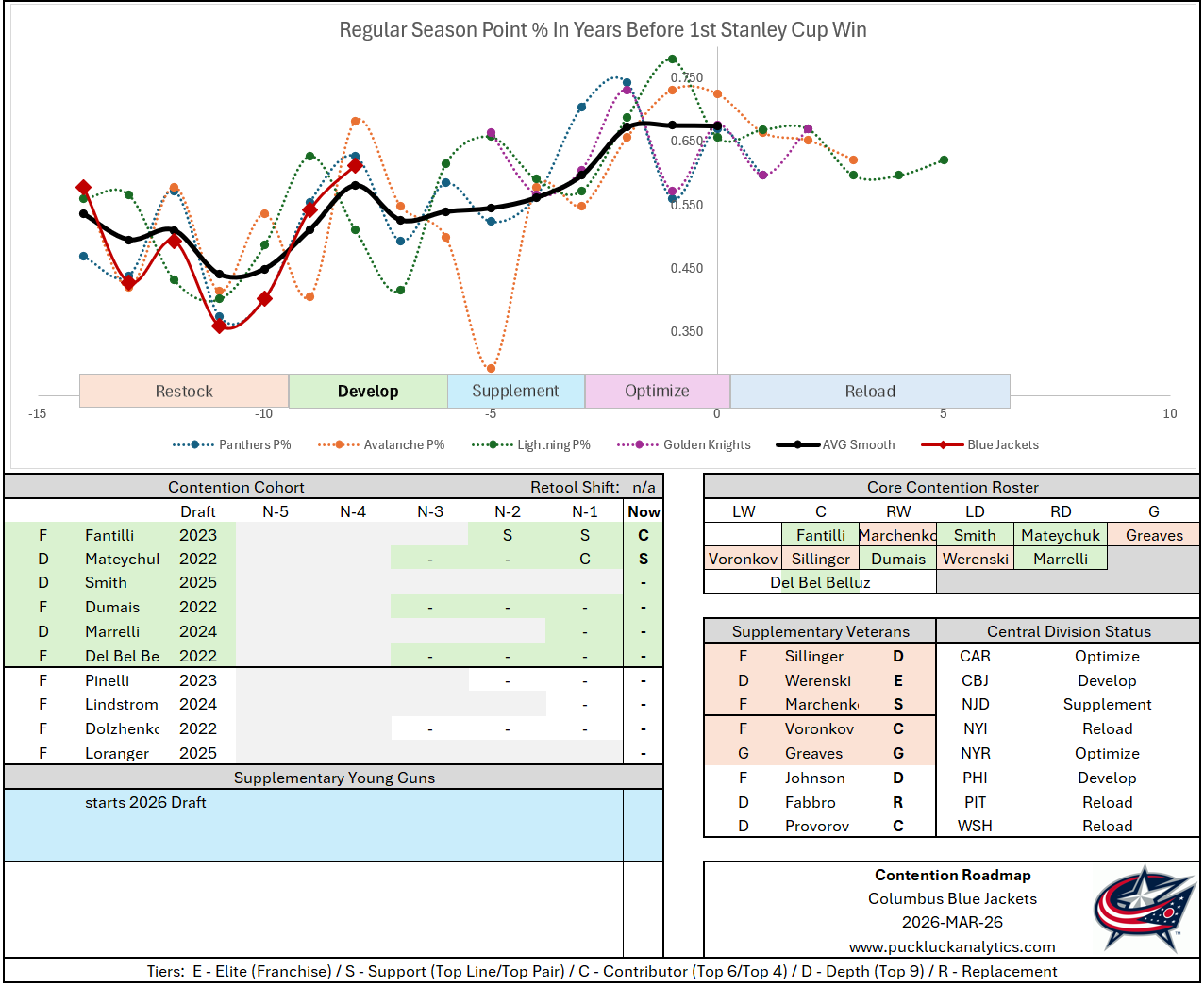
The Columbus Blue Jackets bottomed out a few years ago, picking in the top 6 in four consecutive drafts. It’s set them on a course up the standings after a 6 year hiatus from the postseason.
The building blocks are in place in Columbus. They need time to develop to their full potential, which will give them time to find a few more supplementary pieces through the draft. The back end seems to be very well positioned, so taking some swings for another high impact forward may be their best bet in the next few drafts.
Pittsburgh Penguins
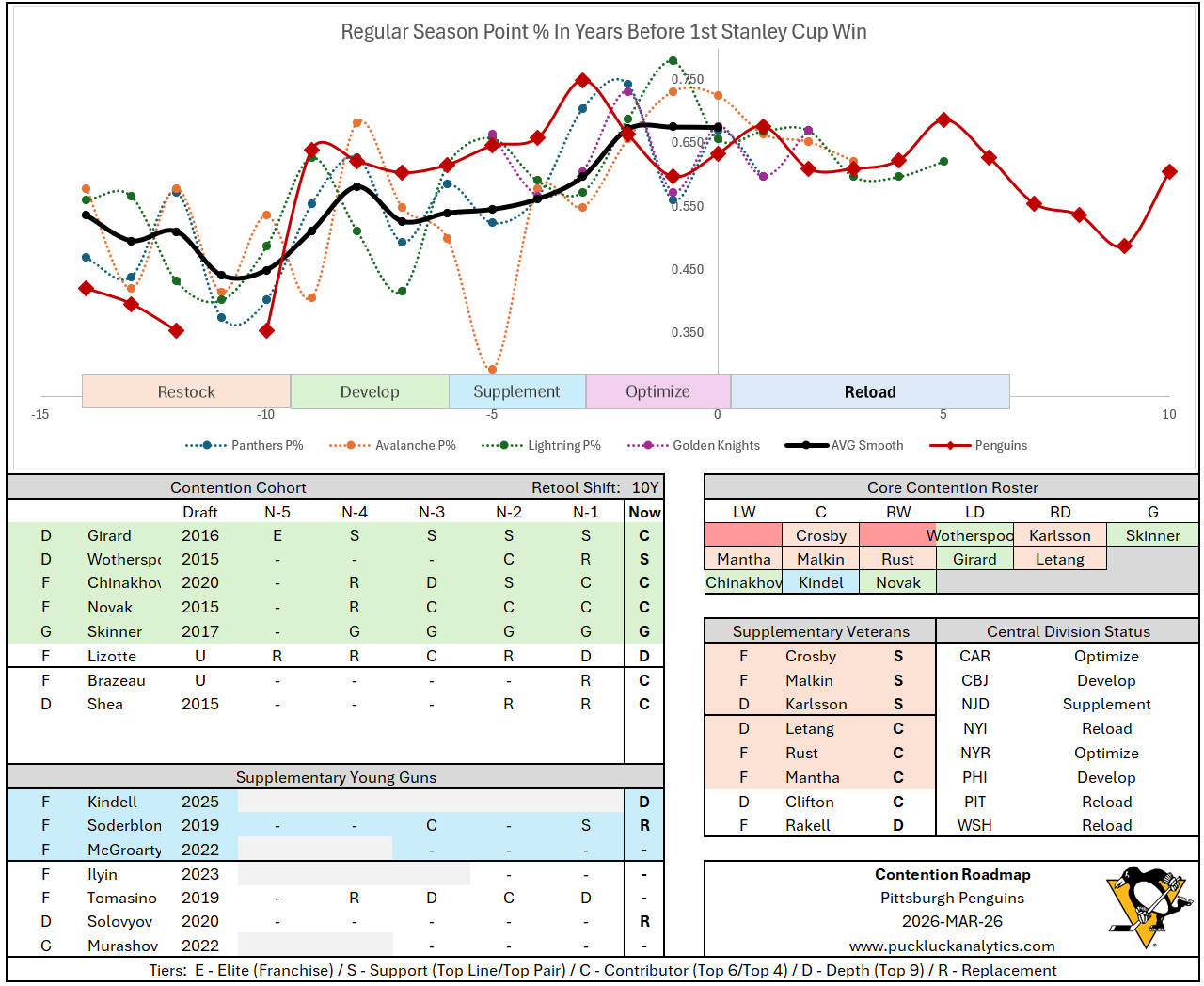
We saw in the Atlantic Division post that the Bruins have been reloading for 15 years after their 2011 Stanley Cup. The Pittsburgh Penguins give us another example of what’s possible with a few Elite anchor players and a rotating supporting cast.
The timeline shown here aligns with the Penguins 2016 Stanley Cup. Of course, they won in 2009 as well. That early win might be considered a bonus in comparison with the other Cup winning timelines of the salary cap era. The Penguins landed an incredible set of anchor talents in their rebuild and Sidney Crosby, Evgeni Malkin, Kris Letang and Marc-Andre Fleury helped them make one of the quickest, sharpest jumps back up from the bottom. Is it possible to win ahead of the typical decade+ long timeline? Yes, the Penguins did it. Getting a group of Elite players was the key. The next question is: can the Penguins continue to remain competitive past the end of the Crosby era, like the Bruins did after Bergeron?
New York Islanders
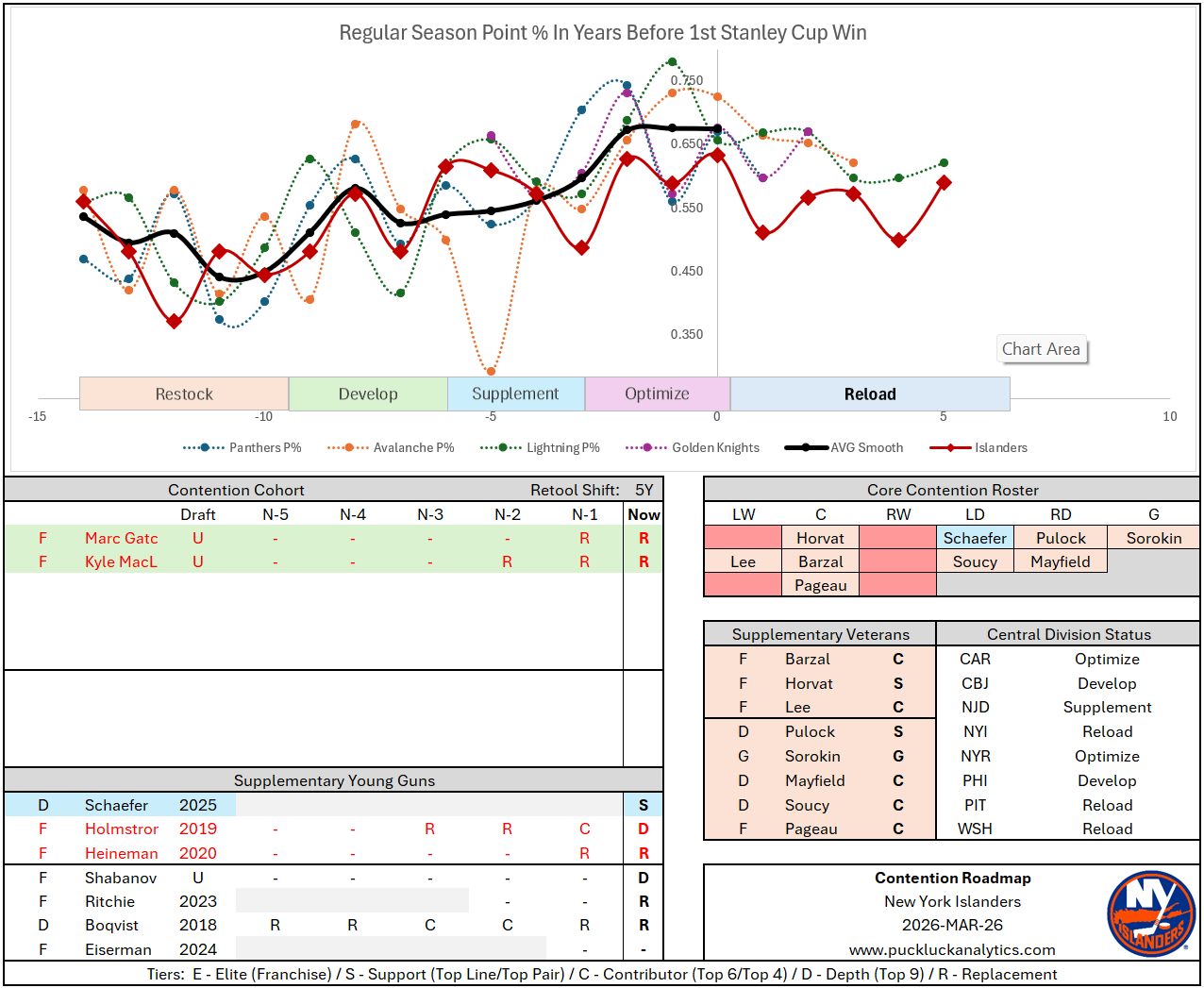
The New York Islanders are either in denial or blissful ignorance. Sure, they won the lottery to land one of the best looking defense prospects in recent memory in Matthew Schaefer. Schaefer is an anomaly though. Their roster is heavily veteran laden.
The departure of Lou Lamoriello from the GM seat was supposed to breathe fresh air into the Islanders front office. Their deadline moves this year suggest otherwise. In are Ondrej Palat, Brayden Schenn and Carson Soucy. Out are a mittful of futures. Schenn and Palat have term left too, so they add to the collective aging curve of the roster. There are a couple of good prospects coming behind Schaefer, but not nearly enough to offset the drag that the inevitable age related decline is going to have on this group.
Philadelphia Flyers
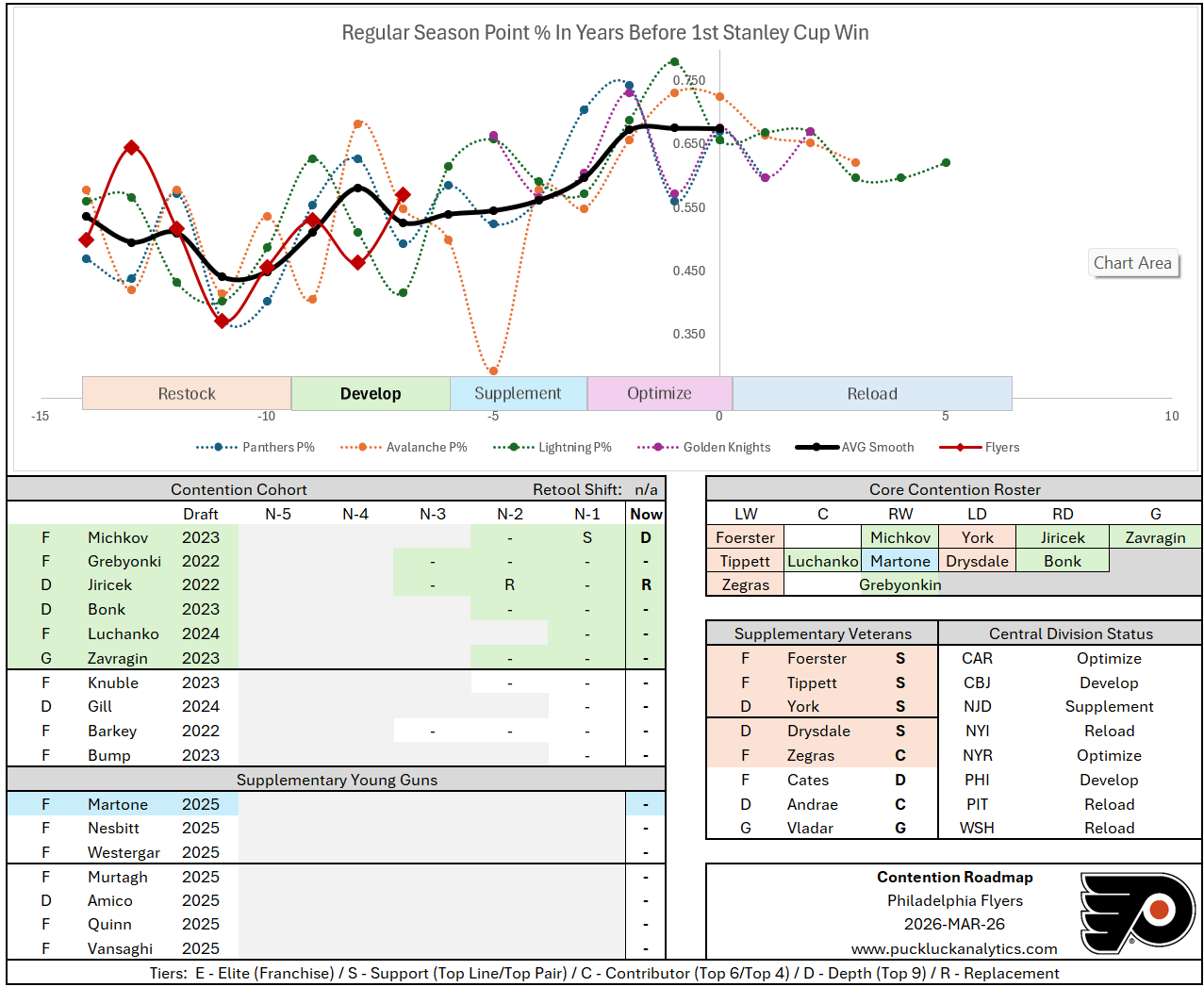
The Philadelphia Flyers seem to have acknowledged their plight a few seasons ago and committed to restocking their cupboards. There’s a budding group that should soon be ready to take the team back into playoff contention.
The concern with the Flyers rebuild at this point has to be that it’s still the veteran group leading the charge. Yes, they’re climbing back into playoff contention. But where are the stars in the Contention Cohort? Matvei Michkov had a rough sophomore season. They added David Jiricek at the deadline but he’s already on his 3rd NHL team in his young career after being a 6th overall pick. No one else in the Contention Cohort has hit the NHL yet. There should be serious concern in Philadelphia that the rebuilt core isn’t good enough.
Washington Capitals
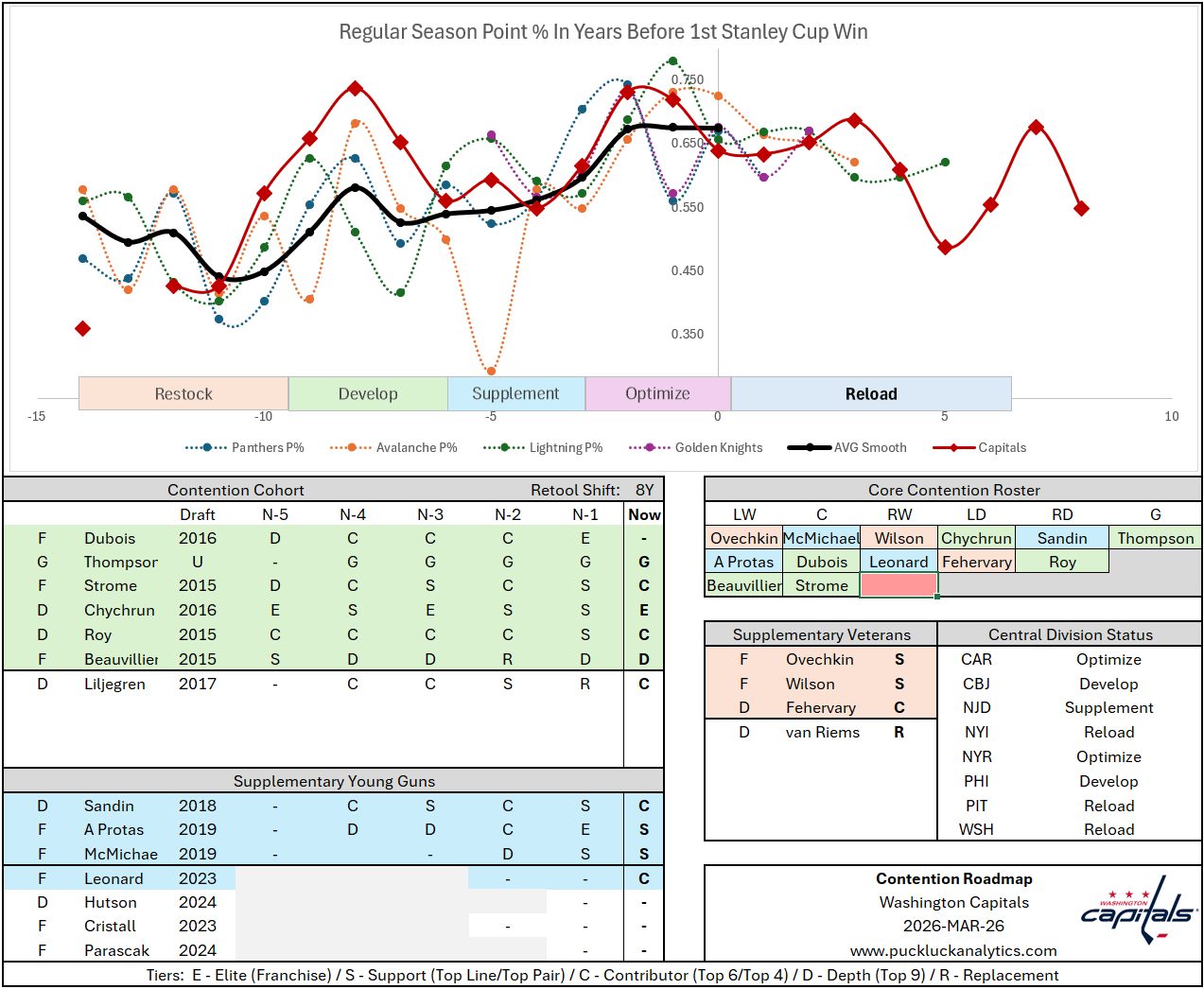
Were we find Crosby and the Pens, we find Alex Ovechkin and the Washington Capitals. Much was made about how long it took Ovechkin to win the Stanley Cup. Yet the win fits the timeline reasonably well. Perhaps it was the prolonged dip in the middle and the contrast with Crosby and the Penguins that left that impression.
The big question for the Capitals is where they will be when Ovechkin hangs up the skates. We’re already seeing some targeted deployment of the superstar and a look at their current roster makeup shows us they’ve already positioned themselves for his eventual departure. The Capitals current success is being driven by a Contention Cohort in their prime. There’s more help on the way, too, with some exciting prospects like Ryan Leonard and Cole Hutson starting to see NHL action.
New Jersey Devils
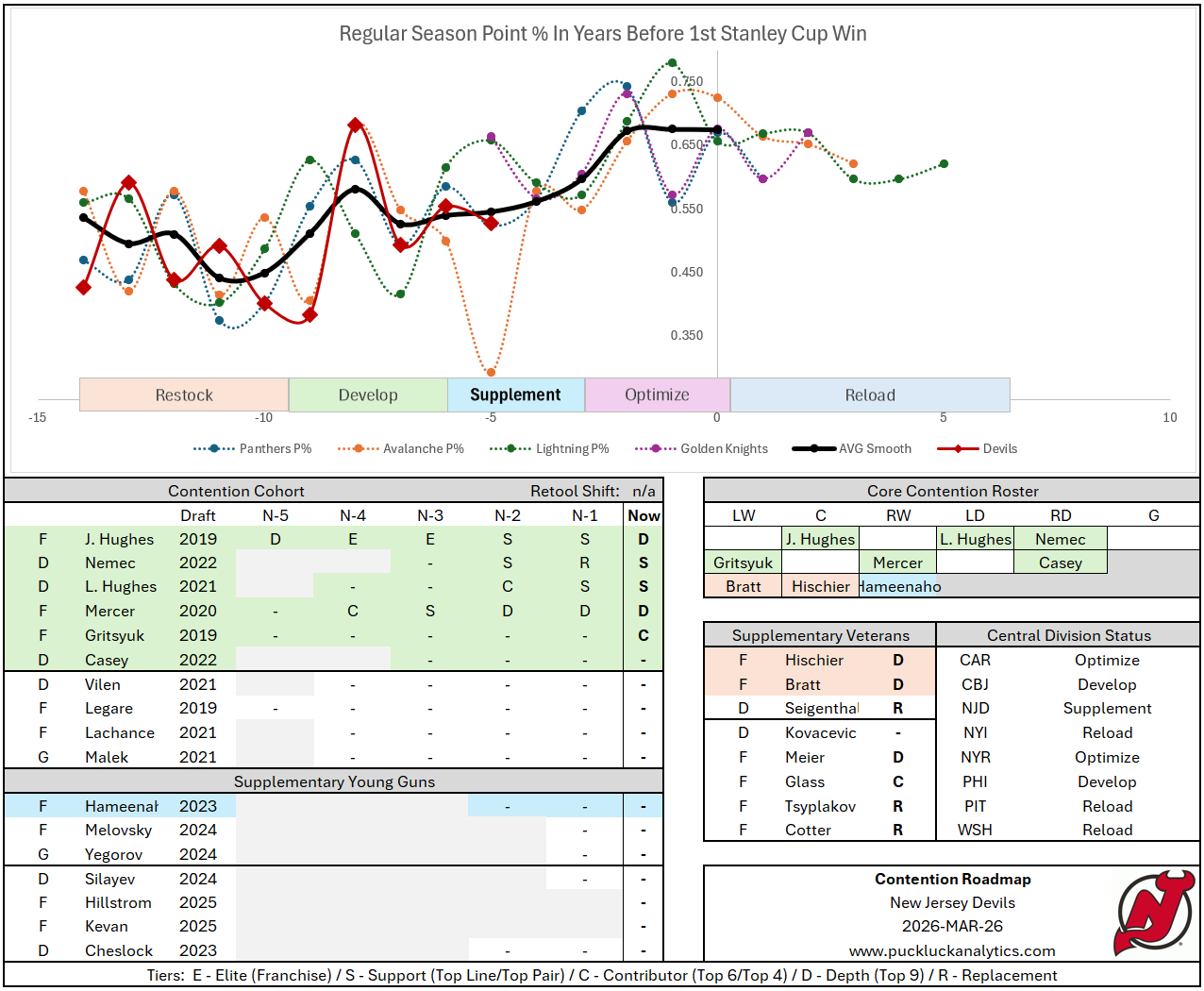
The New Jersey Devils had plenty of promise a few years ago, after a rebuild effort that netted them a promising set of prospects headlined by Jack Hughes. With one disappointing season after another, though, it may be time we have to consider that one good season as the aberration.
The Devils rebuild looks like it’s in serious trouble. Their Contention Cohort still has some promise, but their attempts to add veteran support early in their rebuild thinned out their crop of potential impact pieces before the contention roster really started to take shape. There might be room to salvage it yet. That will take some bold moves to strengthen the Contention Cohort and prospect pipeline. Staying the course looks like a recipe for trouble.
New York Rangers
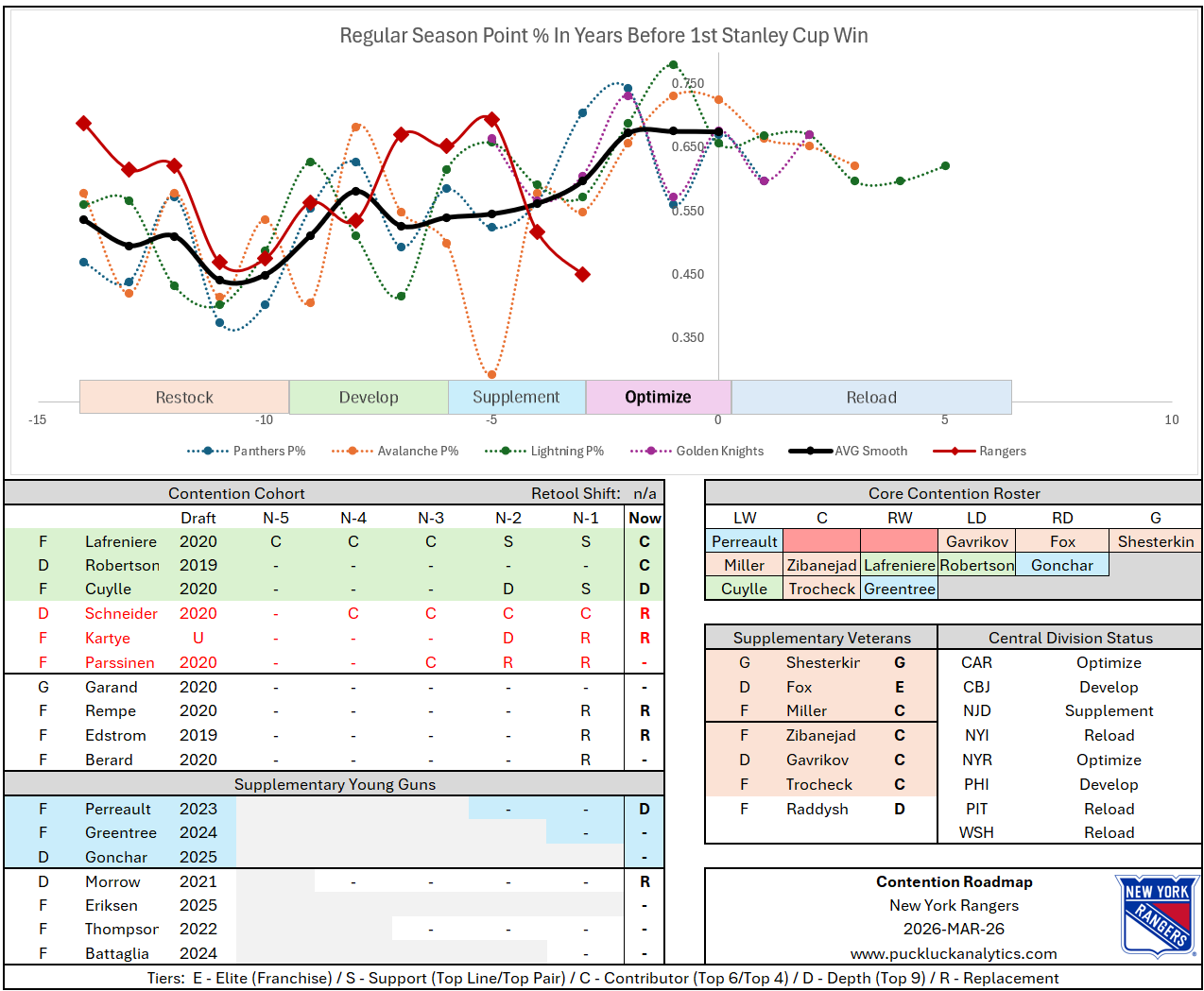
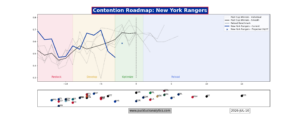
The New York Rangers are in complete denial. Chris Drury’s letter to Rangers fans explicitly stated that ‘this is not a rebuild’. That’s the reason I decided to show their timeline as I did, anchored from their original letter to fans in 2018. Reading between the lines in The Letter 2.0, there’s a strong sense that the current retool effort is simply a punt of the current season and that Drury expects to push for the playoffs again next year.
The Rangers results, along with a veteran heavy roster, suggest that a rebuild is needed. The Contention Cohort is nearly non-existent. The prospect pipeline is thin. There are some quality veterans that could be useful additions to legitimate contending rosters. The time to act is now, before the veteran group erodes.
Metropolitan Division Power Rankings 2030/2031
The Metropolitan is full of teams that aren’t clearly in contention or on a path to it. The Hurricanes have been the class of the field over the past five years and look well positioned to stay there. The Capitals and Penguins will have to figure out life after their generational talents. The Blue Jackets, Devils and Flyers are all trying to pull out of rebuilds and the Blue Jackets look like the only one that isn’t already in trouble. The Islanders and Rangers seem to be in variable states of denial or ignorance.
Metropolitan Division 2030/2031 Power Rankings
- Carolina Hurricanes
- Washington Capitals
- Columbus Blue Jackets
- Pittsburgh Penguins
- Philadelphia Flyers
- New Jersey Devils
- New York Islanders
- New York Rangers
More
That’s a wrap on the initial build of the Contention Roadmaps. You can find the latest Contention Roadmaps here, the post on the Pacific Division teams here, the post on the Central Division teams here, and the post on the Atlantic Division teams here.