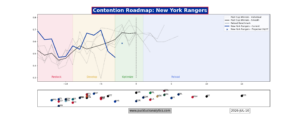
If you’ve been following along here for a while, you’ll know that I’ve spent a lot of time thinking about long term roster building strategy. I’ve looked at various concepts related to roster construction, like player tiers and prospect development alongside historical roster construction strategies of both Cup winning squads and teams that have fallen short. Now, it’s time to put it all together and apply it to the teams in the Pacific Division to see if we can get a sense of where the division is headed in 5-10 years.
If you aren’t already familiar with my definition of player tiers or other concepts used in the team analysis below, you can catch up with with some previous posts:
Contention Roadmaps
I’ve put together Contention Roadmaps that merge the ideas from player tiers, development curves, and historical rebuild timelines. The intent is to get a sense of where each team sits in their development cycle and where the potential strengths and weaknesses are in their long term outlook. Forecasting performance 5 years or more out is no small task given the number of variables and human intervention (yes, looking at you – NHL front office execs) but we should be able to see which teams futures look bright (or not).
Pacific Division Contention Roadmaps
We’re going to take a look at the Pacific Division teams in the order of the current standings as teams ready themselves to return from the Olympic break. Then we’ll postulate what the standings might look like in 5 years.
Vegas Golden Knights
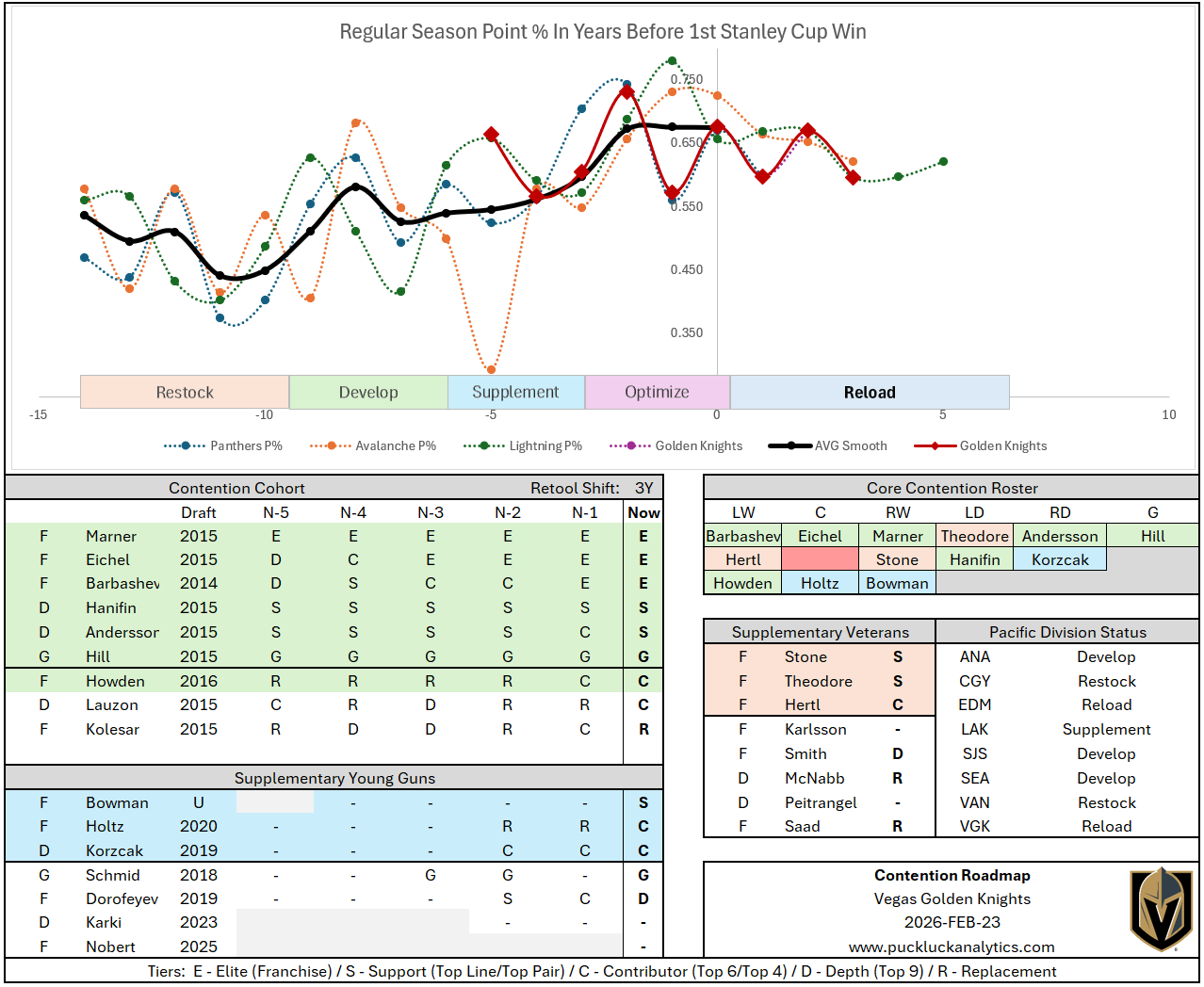
The Golden Knights are the only recent Stanley Cup champion in the Pacific Division and they’re challenging for top spot in the division again this season. The Vegas front office has earned a reputation for being ruthless with their roster building approach, regularly moving on from veteran players. What’s interesting when we look at the moves they’ve made since winning the cup 3 seasons ago, is that they’ve successfully shifted their contention cohort such that they’re still building around a sizable group in their prime.
Mitch Marner, Ivan Barbashev, Noah Hanifin and Rasmus Andersson have all been brought in and the shift in the draft years for their contention cohort still fits the historical rebuild timeline to a cup window. With a few young players chipping in and a few vets still earning their roster spots, the Golden Knights look ready to continue contending for a while. There’s no reason they shouldn’t be looking squarely at the 2026 Stanley Cup and trying to add to go on a long run. Based on the player tiers, they could use a 2C (preferable a Supplementary tier player). That could be via trade. A William Karlsson return from injury could be another boon with no associated acquisition cost.
Edmonton Oilers
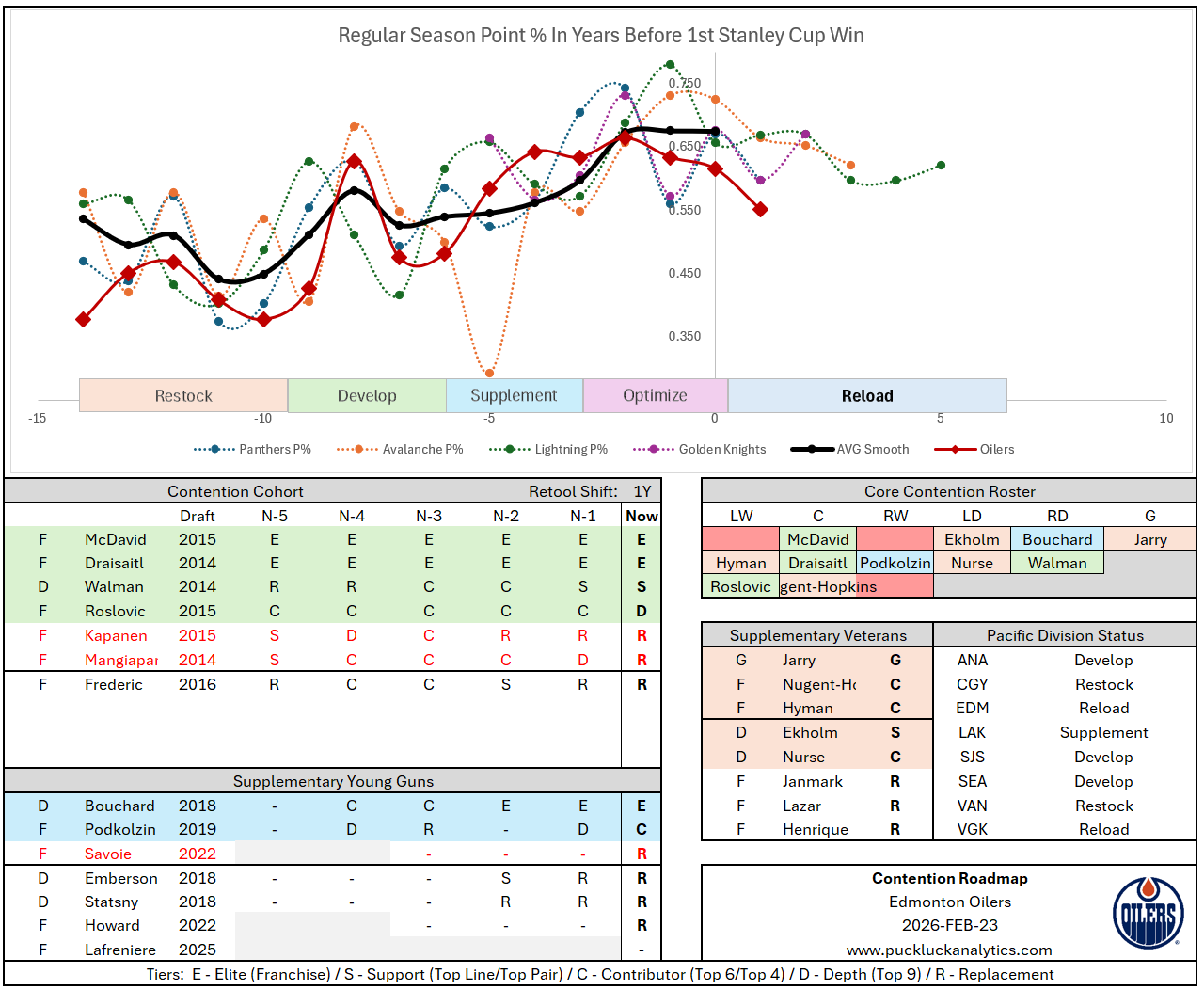
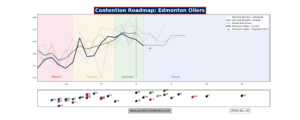
The Edmonton Oilers have fallen short in the Stanley Cup final in two straight seasons. It’s been a slow steady ascent up the playoff mountain in the McDavid era. When we look at their historical regular season point percentage though, it looks fair to question whether their best opportunities with this core have passed.
The current roster is heavy with veteran skaters and the McDavid/Draisatl cohort gets thin fast. There are only 4 skaters from the group that have a suitable player tier to include them in the Core Contention Roster, which is less than ideal. Worse might be the fact that there don’t seem to be many good options coming down the prospect pipeline. As the seasons go by, the front office seems to be leaning harder into bringing in veterans to fill out roster depth and that could very well be the eventual undoing of this core. The clock is ticking loudly in Edmonton.
Seattle Kraken
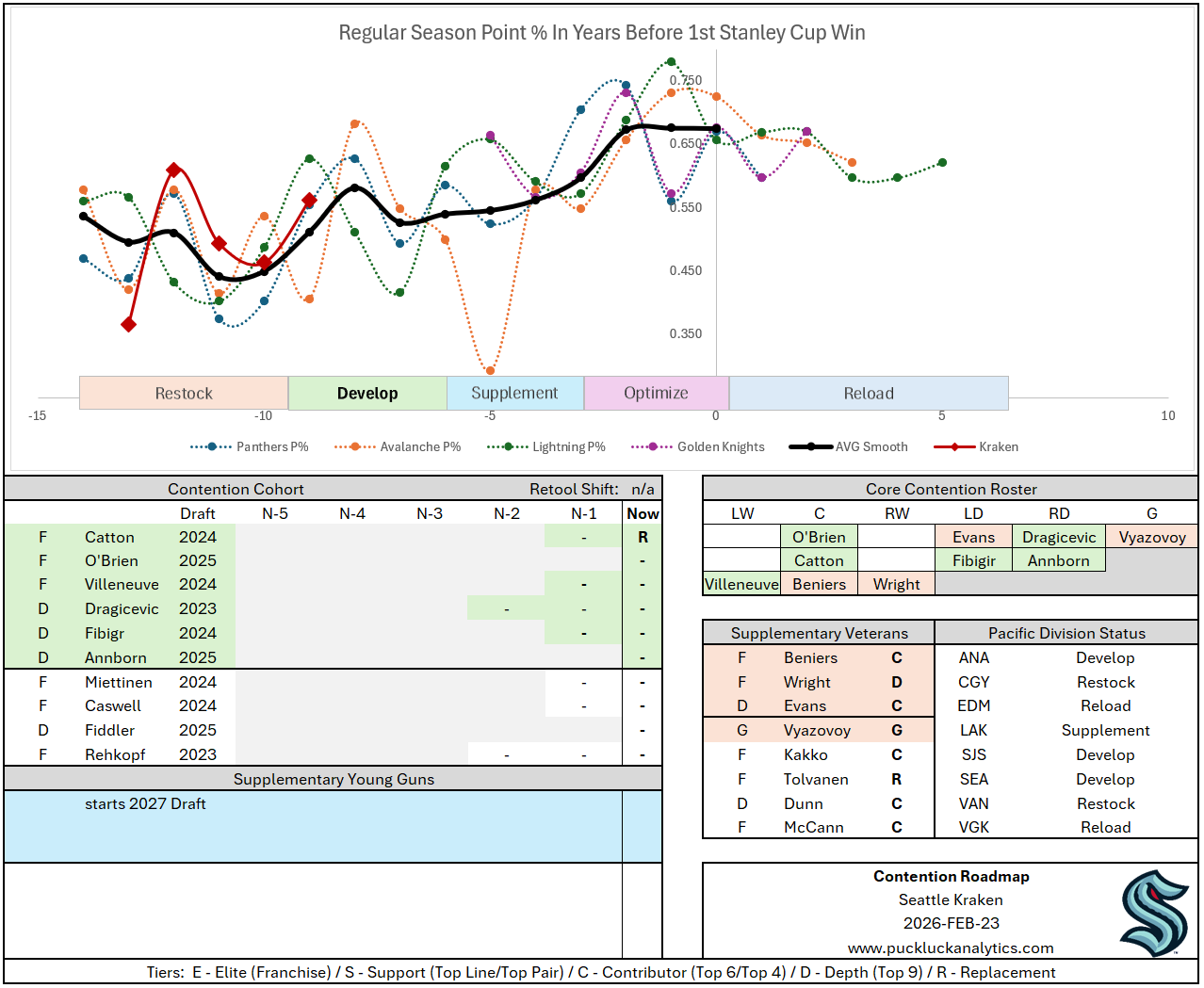
The Seattle Kraken don’t seem to know what they are. A surprising sophomore outing for the 2021 expansion team seems to have convinced the Kraken brass that they’re closer to contention than the data suggests they are.
The Kraken didn’t walk out of their expansion draft in quite the same shape as the Vegas Golden Knights and their most likely path to contention is rooted in the draft. They’ve picked in the top 10 four times in their five years of existence. That’s where they would be best to look for a Contention Cohort to build around. 2024 8th overall pick Berkley Catton is already seeing NHL action and there are a number of promising prospects in the pipeline that could join him. By setting the Contention Cohort as the 2023-2026 draft years, Matty Beniers and Shane Wright fall outside the cohort and could be solid veteran support pieces when this core is ready to contend.
Anaheim Ducks
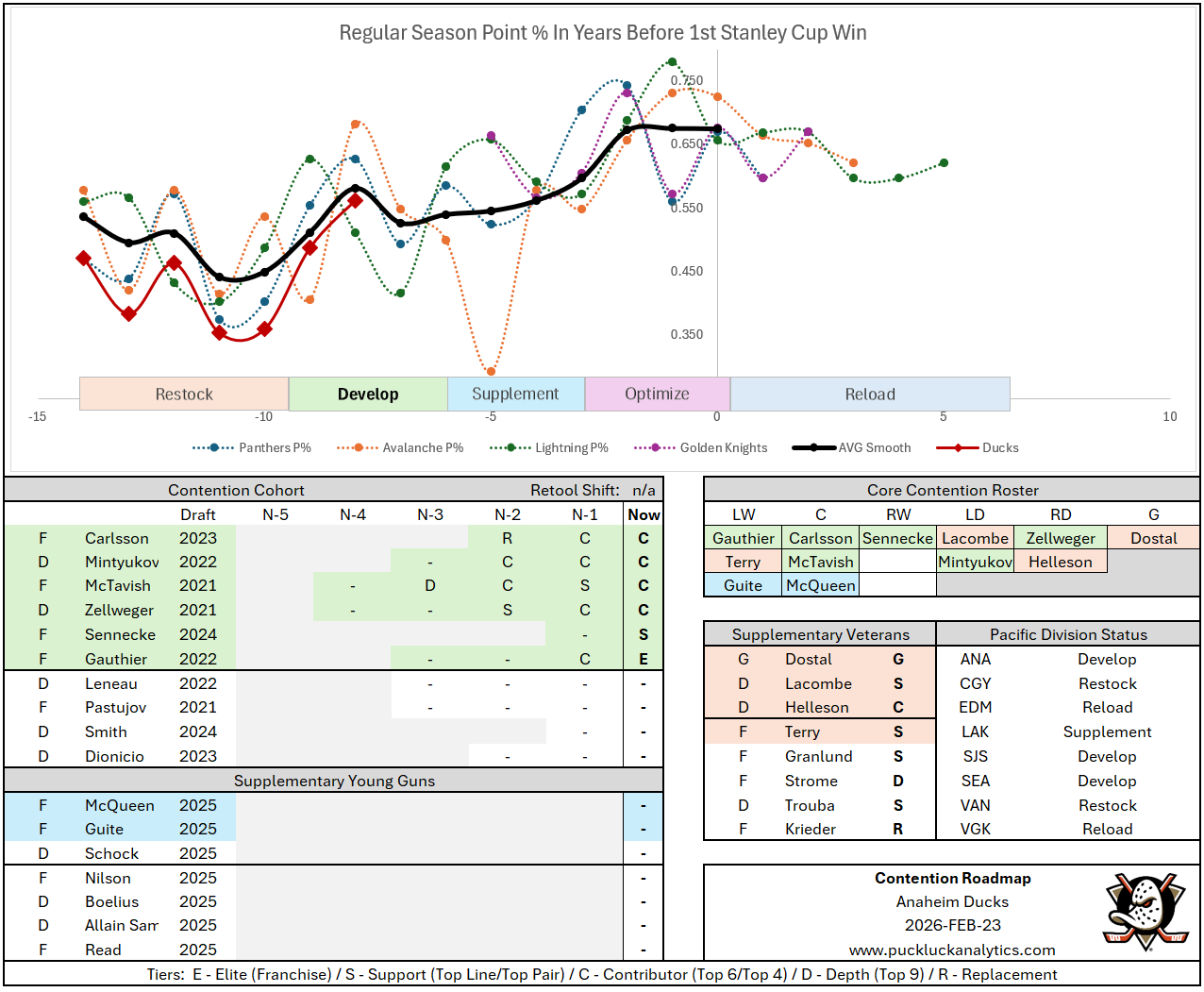
There’s no guessing where the Ducks are in the roster building cycle. They executed a deep rebuild and has a couple of tough seasons recently as a result. It’s starting to pay dividends though, as the new Contention Cohort is leading their initial recover spike in the standings this season. Leo Carlsson, Cutter Gauthier and Beckett Sennecke look like they’ll be a force to be reckoned with in a few years and the Ducks boast a plethora of young talent on the blue line.
What’s interesting in the Ducks pulling out of their rebuild is that they’ve already moved on from the group they started the rebuild with. Trevor Zegras and Jamie Drysdale have both been jettisoned and that looks like a good decision given their progression and the strength of the cohort that was around them. But they didn’t just move on from them either, they added to the current contention cohort and future supplementary cohort in the process with the acquisition of the aforementioned Gauthier and a couple of draft picks in those deals.
Los Angeles Kings
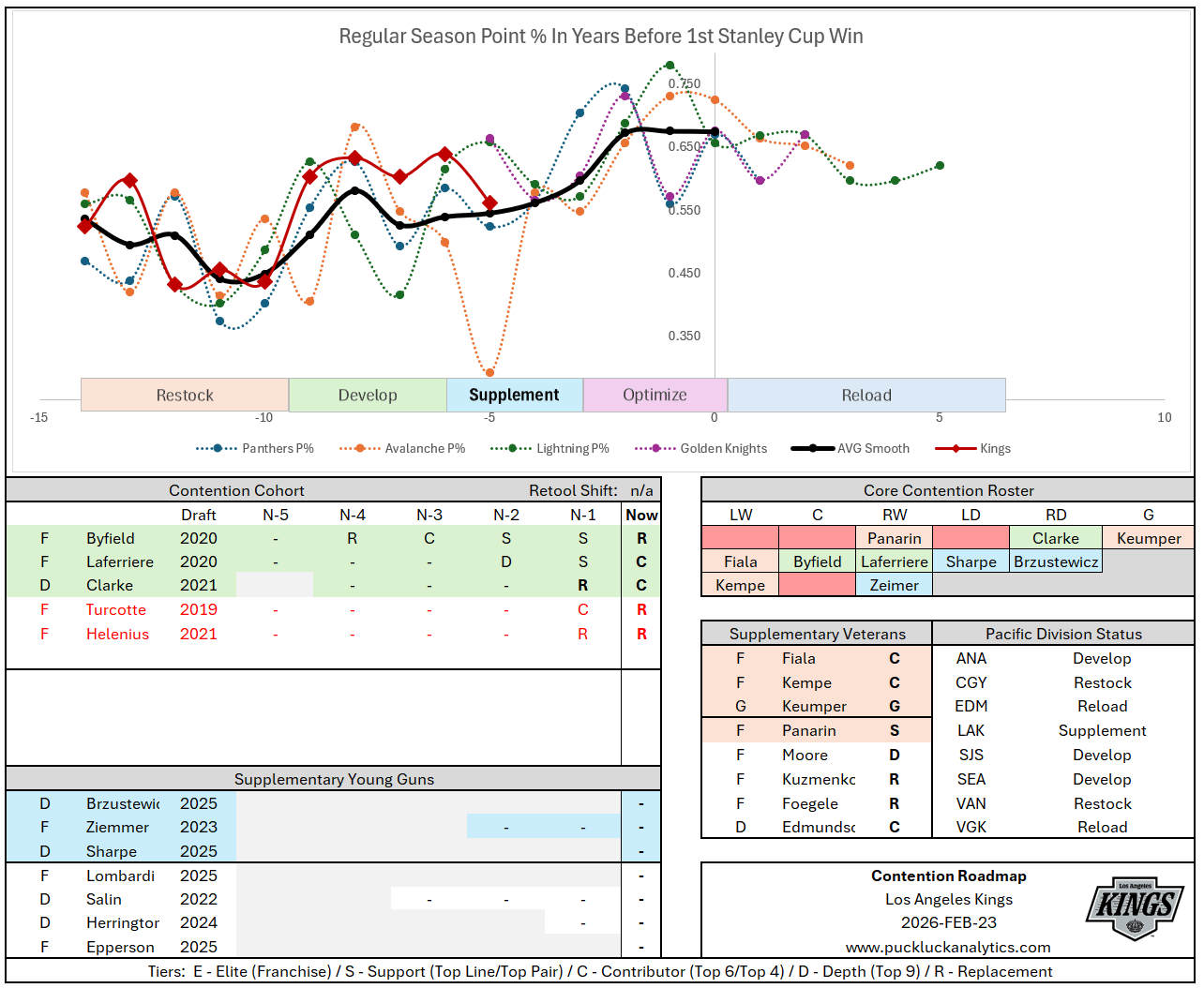
After losing a first round series to the Oilers in four straight seasons, the Kings are in a fight for their playoff lives as the trade deadline approaches. The question may be: are the Kings fading or is their Pacific Division competition getting stronger.
The Kings had one of the most promising looking prospect pools five years ago. Most of that is gone, leaving a slim Contention Cohort if we set the draft range for it based on their rebuild timeline. A large amount of the assets the Kings added through their rebuild have been moved in deals to bring in older support players as they have attempted (unsuccessfully) to find a way past the Oilers. LA find themselves in a place on the timeline where they should be supplementing the core with some young guns, but the core is MIA. The acquisition of Artemi Panarin prior to the Olympic continues the trend, with the Kings sending more futures for an aging skater. There’s a real chance the Kings window has closed before it ever really opened.
San Jose Sharks
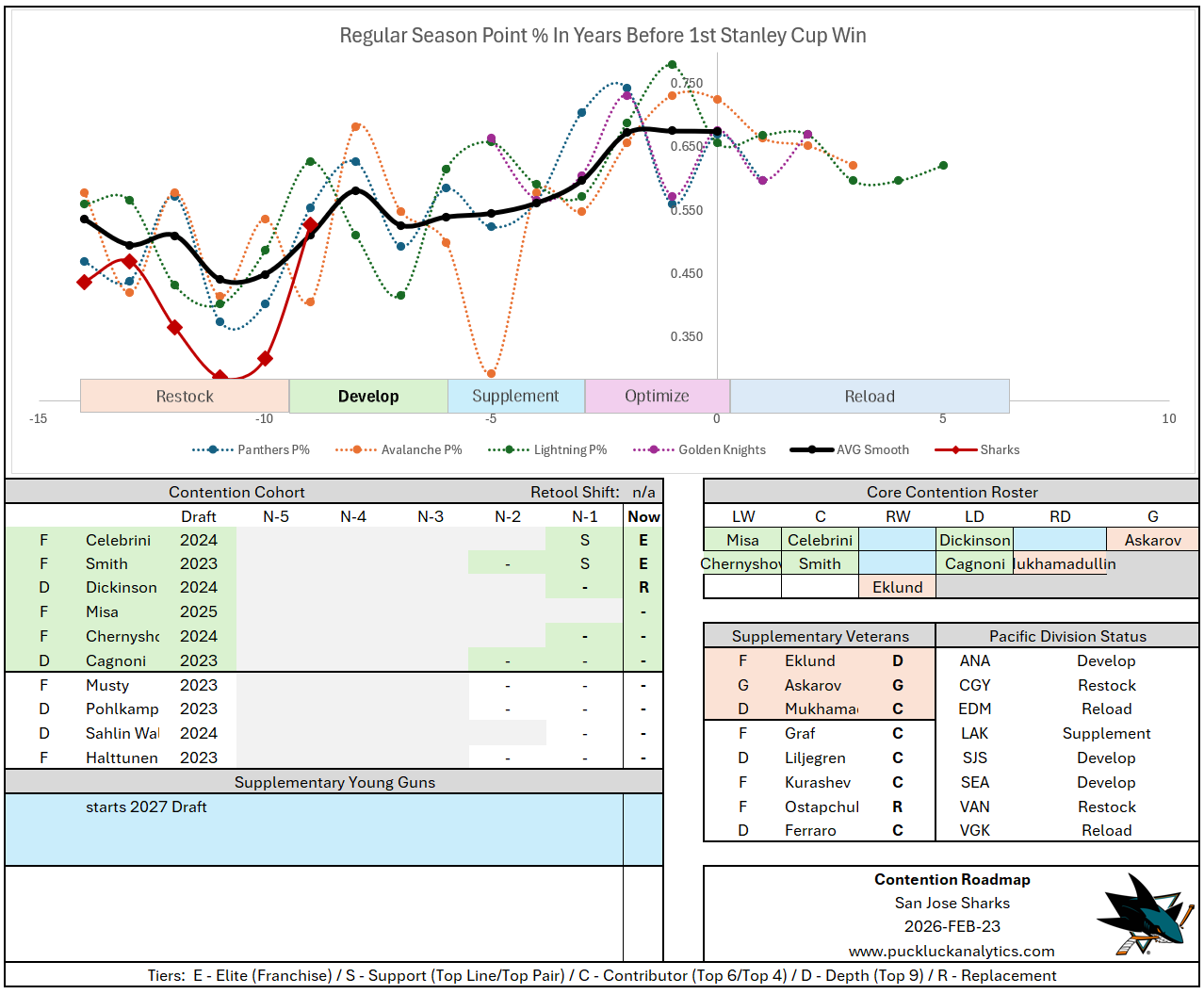
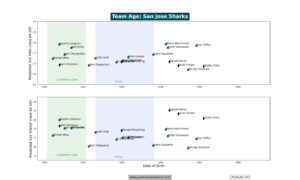
Much like the Ducks, there’s no guesswork involved in figuring out where the Sharks are at in their roster building process. They’ve been anchored at the bottom of the Pacific for the past few seasons and have a notable initial recover spike in progress.
The Sharks boast perhaps the most exciting young forward in the game in Macklin Celebrini and they’ve surrounded him with a plethora of additional talent from recent drafts. Development will be key, but Celebrini already has two running mates from the Contention Cohort with him on the Sharks NHL roster. The Sharks are a team on the rise and the potential is there for them to battle the Ducks for top spot in the Pacific in 5 years.
Calgary Flames
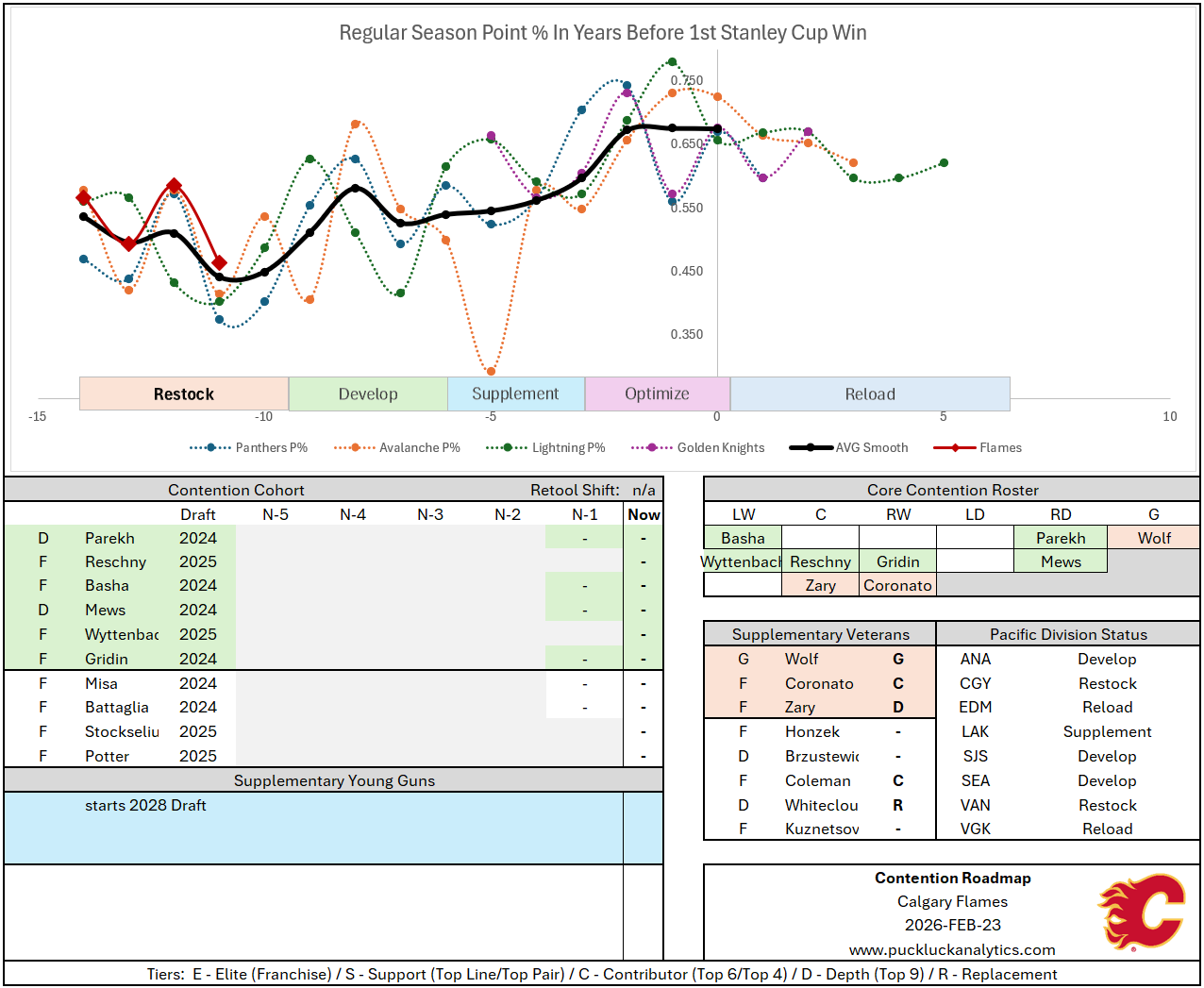
The Calgary Flames missed the postseason by a tiebreaker last season and entered 2025-2026 with ambitions to be one point better to reach the proverbial postseason dance this season. Things have clearly gone in a different direction, which is probably more reflective of the Flames current roster composition. It’s not that the Flames roster is devoid of good NHLers. They have plenty of Guys. It’s the complete lack of Dudes holding the team ceiling down.
The front office can call it a Rebiggle or whatever other term they want. The fact is the Flames are fighting for a top 3 pick in this years draft. That could add some Dude potential to the budding contention cohort that Craig Conroy has started to assemble. There’s reason for cautious optimism in Calgary. While the Flames seem to have done well at the past two drafts, they trail a couple of division foes in their path back to relevance. The Ducks and Sharks have already hit bottom and are rising back to relevance with Dudes already on their roster. The Flames are behind both in their path to fielding a contending roster and it will be near impossible to make up ground if they can’t find their own set of Dudes to build around.
Vancouver Canucks
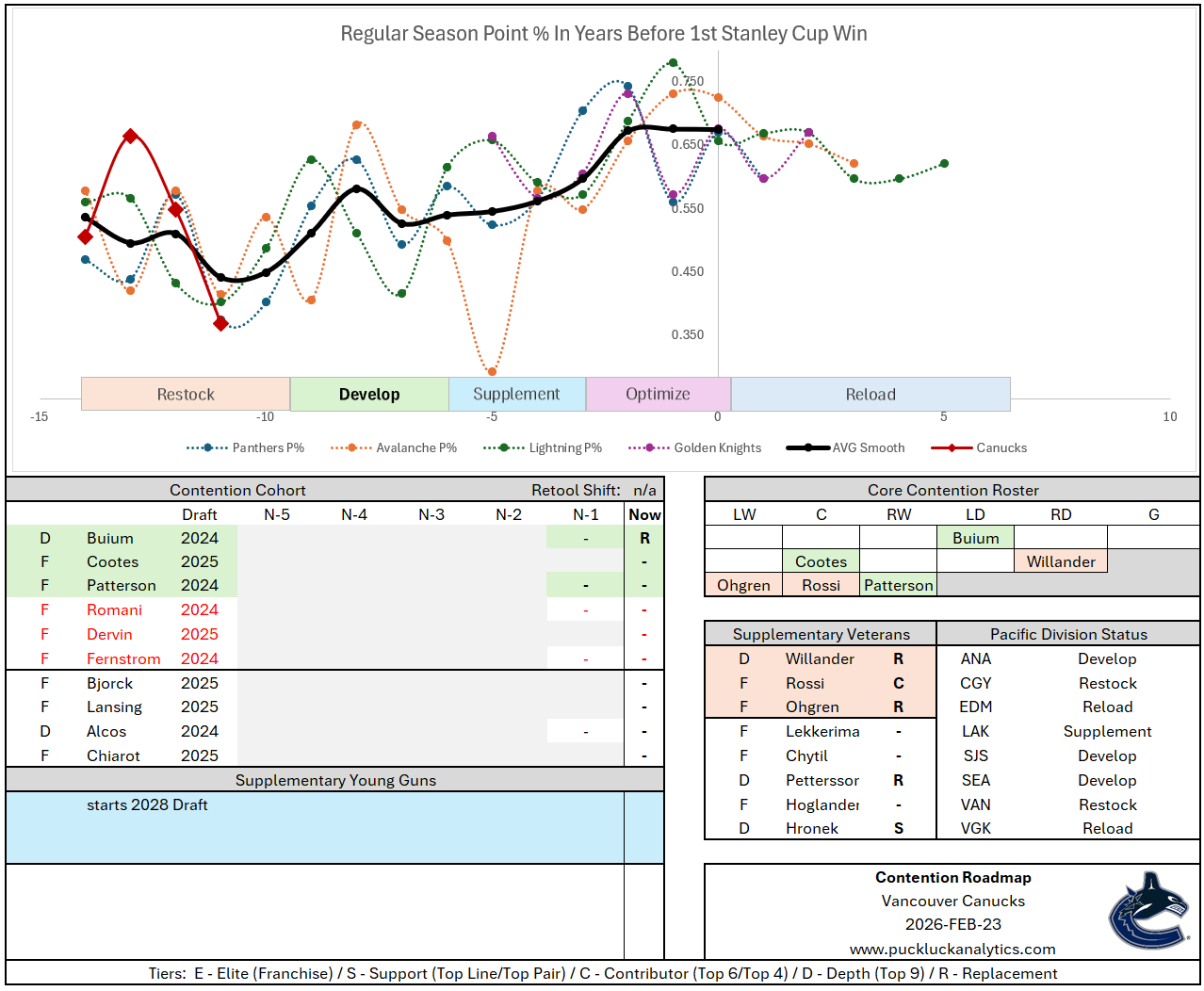
What can we say about the Canucks? They’re in free fall. For the past few years, it seems the front office seems to accept the fact that they need to rebuild, then make a move that discredits that strategy. Perhaps the decision to trade Quinn Hughes will change that as the roster is clearly lacking at this point.
The Canucks are very early in the process, with a 2024-2027 draft Contention Cohort the most optimistic outlook for a rebuild. If that’s the group, it’s going to need a large injection of talent in the next two drafts or the rebuild is going to drag on.
Pacific Division Power Rankings 2030/2031
There are clearly a few teams headed in opposite directions in the Pacific Division. The Sharks and Ducks are exiting rebuilds with promising looks Contention Cohorts. The Flames may be a couple of years behind them if they commit to long term building. The Kings look like they may have short circuited their path to contention and are going in the opposite direction, while the Oilers need to regenerate their roster soon or they’ll be next. Vegas is humming along with a healthy looking long term picture. The Canucks are not. Seattle doesn’t seem to know where they are. It’s very easy to see the possibility that the Pacific could see a changing of the guard over the next five year.
Pacific Division 2030/2031 Power Rankings
- Vegas Golden Knights
- San Jose Sharks
- Anaheim Ducks
- Edmonton Oilers
- Calgary Flames
- Seattle Kraken
- Vancouver Canucks
- Los Angeles Kings
More
Stay tuned for more Contention Roadmaps for the other 3 divisions. You can also find the latest Contention Roadmaps here.